


Syllabus: GS3/Energy Infrastructure; Environment
Context
- The eMobility is turning into a key driver of economic growth, energy security, and a cleaner future, as India is rapidly shifting to electric vehicles (EVs).
What is an Electric Vehicle (EV)?
- An EV is a vehicle powered by an electric motor that uses energy stored in a battery. It can be recharged from an external power source.
- There are four types of EVs:
- Battery EVs (BEVs): These are fully electric.
- Hybrid EVs (HEVs) & Plug-in HEVs (PHEVs): These combine an internal combustion engine and an electric motor to power the vehicle.
- PHEVs additionally have externally rechargeable battery packs for extended electric-only operation.
- Fuel Cell EVs (FCEV): Electric energy is produced from chemical energy.
Why Are Electric Vehicles the Smart Choice?
- Cut Costs: Lower fuel expenses and minimal maintenance.
- Eco-Friendly: Zero tailpipe emissions and a smaller carbon footprint.
- Tax Perks: Savings with lower registration fees & Government incentives.
- Effortless Drive: No gears or clutch-only acceleration & braking.
- Home Charging: Integrated home/public station charging solutions available.
- Silent Ride: An electric vehicle, by its very nature, doesn’t have an engine. Instead, it has a motor system powered by a battery.
Last Decade of India’s EV Revolution
- India’s journey towards electric mobility began in 2015 marked by the launch of the National Electric Mobility Mission Plan and FAME Scheme to incentivize the adoption of EVs.
- It was driven by clear strategic priorities like reducing the rising import bill on petroleum fuels and tackling worsening urban air pollution.
- It aimed to lower greenhouse gas emissions from the transport sector, which accounts for ~9% of India’s total emissions.
EV Adoption in India
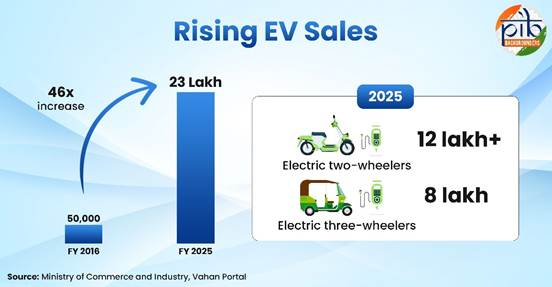
- It has seen a multifold surge, growing from 0.08% in FY15-16 to 8.26% in FY25-26.
- It was driven by motorised two-wheelers (12.8 lakh units) and three-wheelers (8 lakh units) sold in 2025.
- Exports have risen from USD 1.2 million in 2020 to USD 84 million in 2024. Top export destinations included Nepal, Indonesia and Japan.
- In 2025, Uttar Pradesh emerged as the largest EV market with more than 4 lakh units, representing 18% of national EV sales.
- It was followed by Maharashtra with 2.66 lakh units (12%) & Karnataka with 2 lakh units (9% of total sales).
- Expanding Infrastructure: According to Bharat Heavy Electricals Limited (BHEL), 16,561 of the 52,718 public charging stations available as of July 2026 are equipped with fast EV charging facilities.
- The e-Amrit tool helps locate charging stations based on one’s location.
Future Prospects
- India’s EV market, valued at USD 3.71 billion in 2025, is projected to grow to USD 191.04 billion by 2034, at a CAGR of 54.94%.
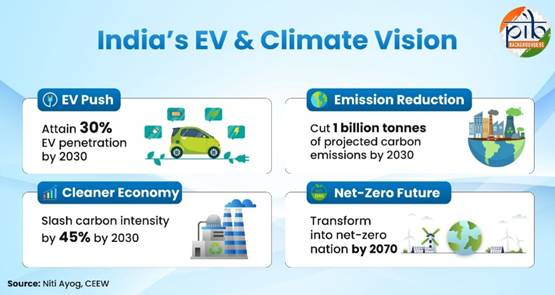
- India aims for 30% of all vehicle sales to be electric by 2030, aligning with the global EV30@30 initiative.
- The EV ecosystem is strengthened with the establishment of 1.32 million charging stations across India by 2030.
Key Concerns Over Electric Vehicles (EVs) in India
- High Initial Cost: EVs are still costlier than conventional petrol/diesel vehicles. Batteries account for 35–40% of the total vehicle cost, making EVs expensive.
- Charging Infrastructure Gap: Limited availability of public charging stations, especially in rural and remote areas.
- Range Anxiety: Many consumers worry that EVs may not have enough battery range for long-distance travel. Lack of charging stations reinforces this concern.
- Battery Life and Replacement Cost: Concerns about battery degradation over time. Battery replacement is expensive.
- Dependence on Critical Minerals: India depends on imports of lithium, cobalt, nickel, and other critical minerals.
- Supply chain disruptions can increase battery costs and affect manufacturing.
- Domestic Manufacturing Challenges: India is still building indigenous battery and component manufacturing capacity.
- Electricity Demand: Large-scale EV adoption will increase electricity demand.
- Requires strengthening of the power grid and promotion of renewable energy integration.
- Environmental Concerns: EVs have zero tailpipe emissions but battery manufacturing and disposal pose environmental challenges.
- Battery Recycling and Disposal: Safe recycling infrastructure is still developing. Improper disposal may create environmental and health hazards.
- Consumer Awareness and Misconceptions: Many consumers believe EVs have very limited range, unsafe, difficult to maintain and cannot perform in Indian conditions.
- Financing and Insurance: Higher upfront cost affects affordability.
- Policy and Regulatory Challenges: Long-term policy stability is needed to encourage investment.
Strategic Policy Interventions for India’s EVs
- National Electric Mobility Mission Plan (NEMMP 2020): It outlines a strategic roadmap to accelerate the adoption and domestic manufacturing of EVs in India.
- It has the twin objective of strengthening energy security and promoting clean,sustainable mobility.
- FAME India: It was launched in 2015 to drive EV adoption under the NEMMP 2020 framework.
- It offers incentives to buyers, supports creation of charging infrastructure, and manufacturing.
- Phase I continued until March 2019, followed by Phase II, implemented over five years until April 2024.
- National Mission on Manufacturing (NMM): It identifies EVs as a key ‘seed’ sector for innovation-led growth. It has ambitious targets for 2035. It aims to double the manufacturing sector’s contribution to GDP from 12.9% (2023) to 25% by 2035.
- It strengthens India’s EV ecosystem by promoting advanced manufacturing, fostering technology development, and integrating EV production into global value chains.
- India Electric Mobility Index (IEMI) by NITI Aayog: It is a first-of-its-kind framework. It tracks and compares the progress of States and Union Territories in advancing electric mobility.
- It evaluates performance across 16 indicators across three pillars-transport electrification, charging infrastructure readiness, and EV research & innovation. This offers a clear snapshot of each region’s ecosystem strength.
- Based on scores, regions are classified as Frontrunners (leading with robust ecosystems), performers (making progress) and aspirants (requiring intervention).
- PM E-DRIVE Scheme, 2014: It is a key initiative of the Ministry of Heavy Industries (MHI). It aims to accelerate EV adoption through targeted demand incentives, support for domestic manufacturing, and expansion of charging infrastructure.
- PM e-Bus Sewa-Payment Security Mechanism (PSM) Scheme, 2024: It provides payment security coverage to each bus deployed for up to 12 years.
- A total of 10,000 electric buses are to be deployed via the Public Private Partnership (PPP) model.
- Scheme for Promotion of Manufacturing of Electric Passenger Cars in India (SPMEPCI), 2024: It promotes electric car manufacturing. It mandates a minimum investment of ₹4,150 crore.
- They need to achieve at least 25% Domestic Value Addition (DVA) by year three and 50% by year five.
- PLI-Auto Scheme: It aims to strengthen India’s manufacturing capabilities in Advanced Automotive Technology (AAT), including EVs.
- It provides financial incentives to promote domestic manufacturing with a minimum 50% domestic value addition.
- PLI For Advanced Chemistry Cell (ACC) Battery Storage: It aims to promote domestic battery manufacturing.
- It intends to establish a cumulative ACC capacity of 50 GWh in India. It supports development of advanced, long-range EV batteries through incentives linked to sales.
- Low GST on EVs: EVs in India attract a concessional GST rate of 5%, which applies to all electric cars, two-wheelers, and three-wheelers.
Driving Forward: India’s EV Growth Outlook
- India is developing the next phases of Corporate Average Fuel Efficiency (CAFE) norms, CAFE III (2027–2032) and CAFE IV (2033–2037).
- These propose stricter CO₂ emission targets based on the Worldwide Harmonised Light Vehicle Test Procedure (WLTP).
- India has entered a decisive phase of scale with demand and production incentives, localization policies, early charging infrastructure.
- It is reshaping itself from an import-dependent market into a globally competitive hub for EV production.
- It is aligned with its strategic priorities of energy security, reduced oil imports, and achieving the 2070 net-zero vision.
Previous article
274 Fugitives Brought Back to India in Past Seven Years: MHA
Next article
The World Development Report 2026
